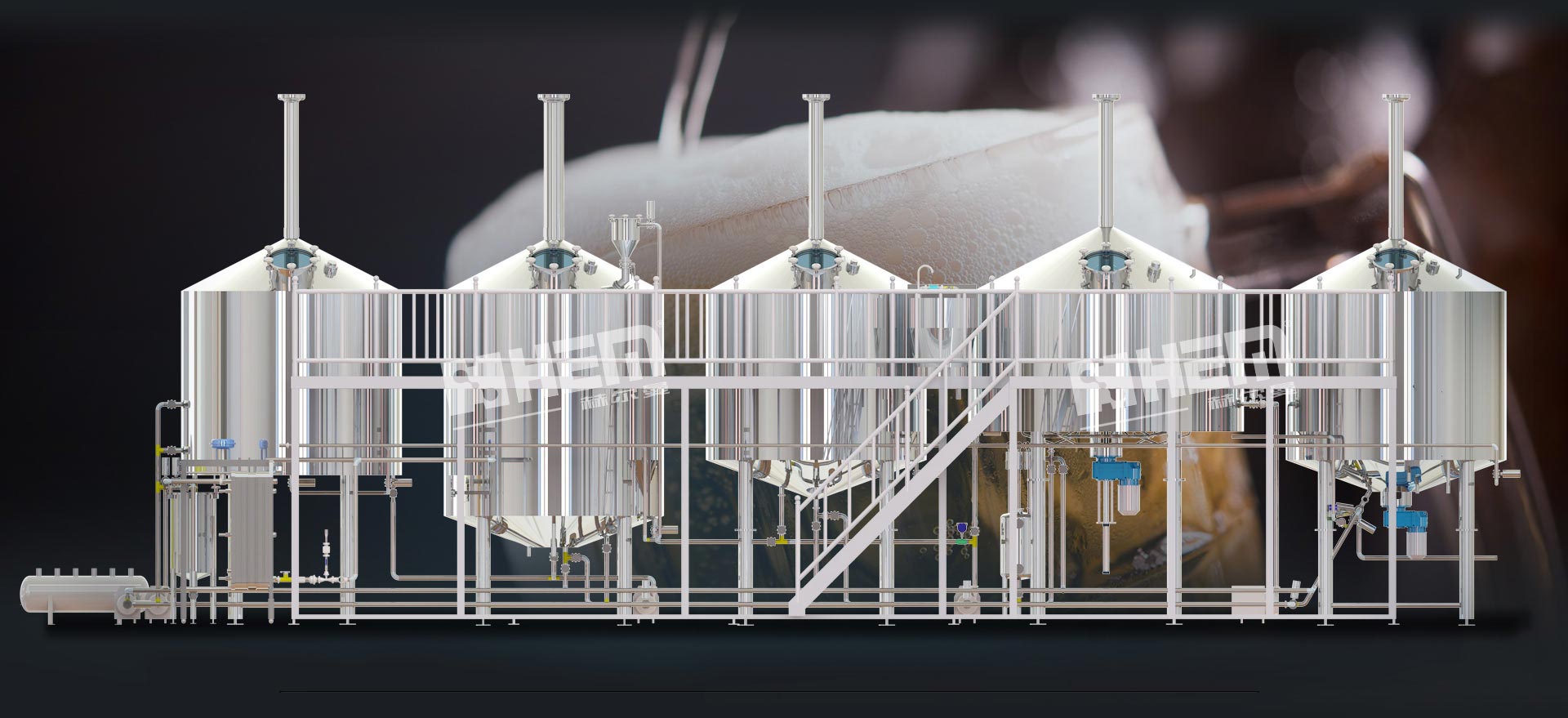
New brewers should consider the hem brew system because it offers equipment options from small 1 HL systems upward, with electric, steam, or direct-fire heating and PID or PLC control configurations. Manufacturer specifications list TIG full-welded joints, surface polishing to ≤0.4 μm, and stainless-steel construction options using 304 or 316 material. Temperature management also matters: brewing research shows that wort mashed at 148°F versus 158°F can differ in apparent attenuation by more than 6%. A system that makes heating, wort movement, cleaning, and process timing easier to repeat gives new brewers more useful batch-to-batch information while reducing unnecessary equipment changes.
For a first brewery, equipment should match planned output before anything else. A brewer producing for a small taproom does not need the same vessel arrangement as a site producing several batches every day. Hem’s published range includes small-batch brewhouses from 1 HL to 10 HL, while larger configurations extend far beyond that range. A 300 L setup, for example, is listed for 1–2 brews per day, with 12 kW of installed power, a 0.45 m² heat-exchange area, and about 35 m² of suggested operating space.
Those numbers give a new brewer something more useful than choosing equipment by tank appearance. At one 300 L brew per day, five brewing days could theoretically produce 1,500 L of wort before fermentation and process losses; at two brews per day, gross weekly volume could reach 3,000 L. Actual packaged beer will be lower because grain absorption, trub, transfers, yeast sediment, and packaging all remove volume. Planning around realistic finished volume prevents a small brewhouse from being paired with too little fermentation capacity.
Brewhouse size only describes part of production capacity. Fermenter count and fermentation time often determine how much beer can actually leave the brewery each month.
A 300 L batch fermented for 14 days occupies a fermenter far longer than the several hours required to produce the wort. Four 300 L fermenters provide 1,200 L of nominal fermentation space, while eight provide 2,400 L. The brewhouse may be capable of multiple weekly batches, but tanks filled with ongoing fermentations cannot immediately accept the next brew. New operators should therefore compare brew frequency, fermentation time, tank count, and packaged volume as one production plan rather than buying the brewhouse first.
Heating configuration comes next because it changes installation requirements and daily operation. Hem lists electric, steam, and direct-fire heating across its brewing equipment, along with electrical configurations including 220, 380, 415, and 480 V depending on project requirements. Small systems may suit electric heating, while higher-output breweries may select steam according to utility access and production layout. The manufacturer also lists PID display panels, semi-automatic PLC touchscreens, and fully automatic PLC configurations.
Control matters most when it keeps temperature repeatable. During mashing, enzymes do not behave the same across the full temperature range. Brewing references place roughly 148°F/64°C near the lower end commonly used for a single-infusion mash and 158°F/70°C near the upper end. Test mashes cited by Brew Your Own showed more than a 6% difference in apparent attenuation between wort mashed at 148°F and wort mashed at 158°F.
A brewer targeting 152°F but repeatedly moving several degrees above or below it may produce beer with a different fermentability from one batch to the next. Lower mash temperatures generally favor more fermentable wort, while higher temperatures produce a larger proportion of less-fermentable carbohydrates. Many single-infusion recipes therefore work around 152–153°F/66°C as a middle range. Equipment that allows the brewer to observe and hold the intended temperature makes recipe records more useful later.
The same principle applies to measurement. Small changes that look minor on paper can become noticeable when repeated across several batches. Brewing literature on small-batch accuracy recommends measuring water salts to around 0.05 g when fine mineral adjustment is needed. A difference of only 15 g in a dark specialty malt can already alter calculated beer color, while mash-temperature measurements taken over a 60-minute rest can show gradual heat loss if a vessel is poorly insulated or heating is not managed carefully.
For a new brewer, repeatability is more useful than adding more controls than the process requires. Recording 64 L of strike water instead of “about 60 L,” holding a mash at 66°C rather than recording “around 65–68°C,” and logging a 60-minute rest creates data that can actually be compared later. After 10 batches, records containing exact temperatures, volumes, gravities, yeast rates, and fermentation times can show where one beer began to differ from another.
| Item to record | Useful level of detail | Why it matters |
|---|---|---|
| Mash temperature | ±1°C | Changes wort fermentability |
| Mash duration | Minutes | Helps compare extraction |
| Pre-boil volume | Liters or gallons | Shows process losses |
| Original gravity | Specific gravity | Measures wort concentration |
| Fermentation temperature | Daily reading | Helps compare yeast performance |
| Final gravity | Specific gravity | Shows attenuation |
| Packaged volume | Liters or gallons | Measures actual batch output |
Once repeatable measurements are in place, vessel construction becomes easier to assess. Hem states that its tanks use 304 or 316 stainless-steel materials depending on specification, with listed plate thicknesses of 3 mm and 2 mm for relevant sections. Its published production information also describes TIG full welding and internal surface polishing down to Ra ≤0.4 μm on listed brewhouse equipment. Smooth, properly finished product-contact surfaces are easier to inspect and clean because fewer rough areas are available to retain organic residue.
Material specifications should be read together with fabrication and pressure testing. Hem describes a five-stage inspection process covering incoming material, production, jacket pressure checks, finished-product inspection, and packing or loading checks. Its published testing procedure states jacket testing at 5 bar, internal-shell testing at 4 bar, a 12-hour air-and-water test, and an additional 48-hour water test before packing. New brewery buyers should request the applicable records for the equipment being quoted rather than assuming every configuration uses identical limits.
A specification sheet is more useful when each number can be connected to the vessel drawing, electrical plan, pressure record, and intended brewing process.
Site requirements deserve the same attention. Hem lists a preferred 4-inch floor drain for small-batch installations and a ceiling height around 10.5 ft for its 1–10 HL category, although custom heights are available. A published 500–800 L configuration lists about 55 m² of required area, 15–40 kW of power, and a height near 2.5 m. A listed 1,000 L installation rises to about 90 m² with 25–80 kW, depending on configuration.
Those figures show why a new brewer should check the building before ordering tanks. A vessel can physically fit through the brewery area yet still be difficult to install because of door width, ceiling clearance, utility routing, drainage slope, ventilation, service access, or the space required to remove pumps and valves. A floor plan should include working clearance around the tanks rather than showing only vessel footprints. For a 35 m² equipment area, even 10% of floor space lost to poorly placed utilities removes 3.5 m² that staff can no longer use effectively.
Capacity planning should then move from floor space to wort cooling. Hem publishes heat-exchange areas of 0.45 m² for one 300 L setup, 0.70 m² for listed 500–800 L equipment, and 2 m² for a listed 1,000 L system. Heat exchanger performance also depends on wort temperature, coolant temperature, coolant flow, wort flow, fouling, and plate configuration, so surface area alone cannot predict cooling time. A buyer should request the expected knockout time using the brewery’s real incoming-water or glycol temperature.
Cooling speed matters because wort leaves the kettle near boiling temperature and must reach a yeast-appropriate pitching temperature. If one 300 L batch can be cooled and transferred in 35 minutes while another takes 70 minutes because summer water is warmer, the difference affects the entire brewing schedule. For breweries planning two brews per day, an extra 35 minutes per batch adds more than 11.5 hours across 20 brewing days in a month.
Cleaning time deserves similar calculations. A brewery running 2 batches per day for 250 brewing days performs 500 brewhouse cycles in a year. Saving even 10 minutes of setup, transfer, or cleaning time per cycle equals more than 83 working hours annually. The useful question is therefore not whether equipment is “easy to clean,” but how many vessels, hoses, valves, pumps, spray devices, and manual connections must be cleaned after each brew.
New brewers should also separate brewhouse cleaning from fermentation sanitation. Hot-side equipment handles grain, proteins, hop material, and wort, while cooled wort downstream of the heat exchanger can be exposed to microorganisms that compete with brewing yeast. A polished stainless surface helps with cleaning, but sanitation still depends on chemical concentration, contact time, temperature, mechanical coverage, and whether valves and fittings allow full access. In a 2026 equipment purchase, written cleaning procedures should be reviewed before the first commercial batch, not developed after production starts.
Process layout can further reduce unnecessary transfers. Hem offers 2-vessel, 3-vessel, and 4-vessel brewhouse configurations across parts of its range. More vessels can separate operations and support higher brewing frequency, but they also increase piping, valves, pumps, floor area, cleaning work, and purchase cost. Hem lists 10 BBL systems capable of around 1–2 brews per day and larger 20–30 BBL configurations at roughly 2–3 brews per day in specified layouts.
A first brewery does not automatically need the configuration with the largest vessel count. If expected sales require 600 L per week, installing equipment designed around several thousand liters of weekly wort may leave expensive capacity unused. If demand requires 3 batches every brewing day, however, a layout that forces one vessel to wait for another stage can limit output. Batch sequence should be drawn by the hour before equipment selection: water heating, mash-in, rest, lautering, boil, whirlpool, cooling, transfer, and cleaning.
The same hour-by-hour review helps assess automation. PID control can manage selected temperatures without requiring the operator to make constant manual adjustments, while PLC-based systems can provide broader programmed control depending on configuration. Automation does not correct a poor recipe, blocked transfer, unsuitable water chemistry, or weak sanitation. It is most useful when the brewer already knows which temperature, timing, pump, or valve state should be repeated.
For staff training, repeatable controls can reduce variation between operators. If three brewers make the same 500 L recipe, written settings allow each person to follow the same mash temperature, rest time, pump sequence, and transfer method. Compare that with instructions such as “heat until it looks right” or “open the valve about halfway.” After 50 production batches, small differences in manual handling can make records difficult to compare even when the ingredient bill remains unchanged.
The purchase should finally be judged against several years of use rather than the first brewing week. Pumps, seals, valves, heating elements, probes, control components, and heat-exchanger gaskets are service items. Before purchase, a brewer should ask which parts are standard, which are proprietary, expected replacement intervals, spare-part lead times, electrical documentation, and whether remote support is available. Hem lists internet connectivity for remote access on applicable systems and describes installation, training, and recipe support among its service offerings.
A new brewer comparing equipment in 2026 can therefore work from measurable requirements: planned liters or barrels per week, 1–3 expected brews per day, available square meters, electrical service, ceiling height, drainage, cooling-water temperature, fermenter count, and staff hours. Match those numbers to vessel capacity, heating method, control level, heat-exchange specification, inspection records, and service access. Equipment that fits the real production plan is easier to learn, measure, clean, repeat, and expand than equipment selected mainly by maximum advertised capacity.