Seventy-Two Hours of Pool Credits: A Statement You Can Audit
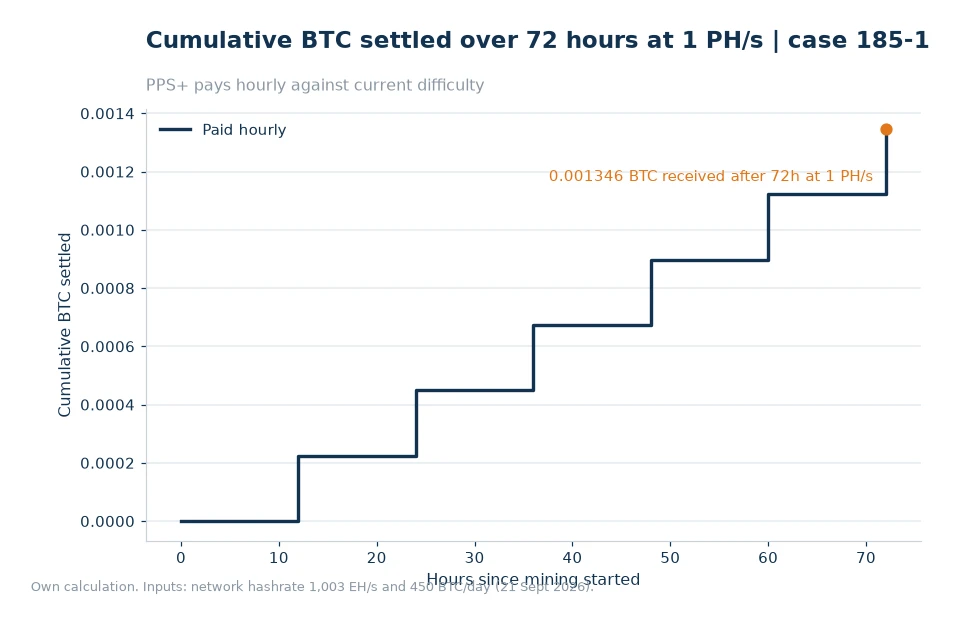
Three days is long enough to catch a billing error and short enough to remember what you changed. At 1 PH/s the pool credits 0.00001869 BTC an hour, which becomes 0.00134582 BTC after 72 hours, or $113.98 at $84,692 per BTC. Treat that window as 72 separate rows instead of one total and the whole figure becomes checkable with a calculator.

Key takeaways
- One hour at 1 PH/s is worth 0.00001869 BTC; 72 hours add up to 0.00134582 BTC.
- The full window is $113.98 at $84,692 per BTC, and that is before electricity.
- An hour that never landed appears as a flat gap of 0.00001869 BTC, not as a rounding difference.
- A review only means something if you recorded the hashrate you actually ran beside the credit you received.
What a three-day window can prove
A 72-hour review answers a narrow question well: did the pool pay for the shares my machines actually produced? It cannot tell you whether the machines were a good purchase, and it cannot tell you where difficulty is heading. Those questions need months and a spreadsheet. The narrow question needs only two columns and a little discipline, which is exactly why it is worth doing first.
Pick the window deliberately. Starting at midnight makes the arithmetic easier, but a mid-afternoon start is fine as long as you note the minute. What matters is that the same 72 hours appear in both records: the credit history on the pool side and your own note of hashrate, outages and firmware changes. Without the second record you are auditing a number against nothing.
Write the hashrate down as a range if it moved. A container that ran at 1.02 PH/s for two days and 0.94 PH/s for the third has not produced the same total as one that held 1 PH/s throughout, and averaging the three days hides the reason the third day looks light.
Why the staircase climbs in equal steps
Under PPS+, the block-reward component is settled hourly against the difficulty in force at the time. Each hour is its own calculation from the shares submitted in that hour, so the cumulative line is a staircase: flat within the hour, a step up at each settlement. When your hashrate is steady, the steps are the same height, and 72 of them land on 0.00134582 BTC.
Steady is the operative word. The chain input for this window is a network hashrate of about 1,003 EH/s and a subsidy of 3.125 BTC per block across 144 blocks a day, which gives 450 BTC a day across the whole network. Your share of that is your hashrate divided by the network total, and nothing about your container changes the denominator. A difficulty estimate of −2.12% was circulating on the read date, and if it lands, every step gets slightly taller. That is a reason to date-stamp the review, not a reason to delay it.
The flat stretches inside each hour are also information. They show that settlement is a batch process, not a continuous drip, which is why two miners checking at 10:40 and 10:50 can see different totals for the same morning.
Put Pool Hashrate beside your own figure
The rear-view number most operators skip is the pool's own size. Pool Hashrate tells you how much of the network the pool is directing, and that figure is the reason two miners with identical rigs can see different credit cadences on different days. When the pool grows, your slice of each pool block is smaller even though your machine has not changed. Hourly PPS+ settlement softens that, because the credit tracks shares rather than the pool's luck, but the underlying share of the network is still the thing being divided.
Reading both numbers side by side also gives you a sanity check on your own dashboard. If your account reports 1 PH/s and the pool's published figure has doubled since last quarter, your expected hourly credit in BTC should have fallen by roughly half at constant network hashrate. Seeing that relationship once makes every later shortfall easier to interpret.
The ViaBTC Mining Statistics page is where both the pool figure and the network figure sit, and it is the page to open before you accuse anyone of short-paying you. A second view, the pool state dashboard, is useful when you want the live picture rather than the summary.
Where the listed 4% sits in the line
The rate card is easy to misread, so here it is in one place. PPS+ is the default scheme. It carries a listed 4% on the PPS-settled block reward and a listed 2% on the transaction-fee component, which is distributed on PPLNS logic. The two rates apply to different parts of the income, not to one combined total. A miner who adds them and calls the result 6% is describing a fee that does not exist.
In a 72-hour statement the deduction is already inside each credit, so the staircase you see is net of the listed rates. If you want to reconstruct the gross, divide by 0.96 for a block-reward-only window. At 1 PH/s that puts gross near 0.00140190 BTC against the 0.00134582 BTC credited, a difference of roughly 0.00005608 BTC, or about $4.75 across the three days. Withdrawals are separate again: mining payouts carry no withdrawal fee, so the credit total is what reaches the wallet.
Three checkpoints worth writing down
You do not need all 72 rows on paper. Four checkpoints catch almost every failure: one early step, one mid-window step, one late step and the endpoint. If the increments between them match the hourly rate, the missing rows almost certainly did too.
| Checkpoint | Cumulative BTC | Value | Added since prior row |
|---|---|---|---|
| Hour 12 | 0.00022430 | $19.00 | 0.00022430 BTC |
| Hour 36 | 0.00067291 | $56.99 | 0.00044861 BTC |
| Hour 60 | 0.00112152 | $94.98 | 0.00044861 BTC |
| Hour 72 | 0.00134582 | $113.98 | 0.00022430 BTC |
The two half-rows are not errors. They cover 12 hours each while the middle rows cover 24, so they carry half the BTC. Reading a checkpoint table without checking the interval is the most common way to conclude that a healthy account is broken.
Worked example: rebuilding the total by hand
Start from the network and finish at the dollar figure, in the same order the pool does.
- Split the 450 BTC the network issues each day across 1.003 billion terahashes, which gives 0.00000044865 BTC per terahash.
- Scale that to a petahash: multiply by 1,000, arriving at 0.00044861 BTC for a full day.
- A day holds 24 settlement hours, so one hour is 0.00044861 ÷ 24 = 0.00001869 BTC.
- Seventy-two settlements at that size total 72 × 0.00001869 = 0.00134568 BTC, which rounds to 0.00134582 BTC once the unrounded hourly figure runs through.
- Price the endpoint: 0.00134582 × 84,692 gives $113.98.
- For a failure case, drop six hours and you lose 6 × 0.00001869 = 0.00011215 BTC, about $9.50, ending at 0.00123367 BTC.
Frequently asked questions
Is 72 hours enough to judge whether the pool is paying correctly?
Yes for arithmetic, no for strategy. If 72 hourly steps at 0.00001869 BTC add up to 0.00134582 BTC at 1 PH/s, the settlement path is working; judging whether mining is worthwhile needs a much longer cost record.
Why did my total land slightly below the chart?
Most shortfalls come from an hour of downtime, a firmware reboot or a hashrate dip that was never written down; a six-hour gap alone removes 0.00011215 BTC, or $9.50 at $84,692.
Does the difficulty estimate change the 72-hour figure?
Only after it takes effect. The estimated −2.12% adjustment read on 21 Sept 2026 would lift each hourly step a little, so date-stamp the window rather than comparing a pre-adjustment total with a post-adjustment one.
Audit one window, then leave the dashboard alone
Run this check once a quarter, on a window you chose in advance, and keep the note. The value is not in watching the curve; it is in having a dated record that proves the account behaved when you were not looking. Between reviews, set a single alert for a hashrate drop and let the Profit Calculator handle the what-if questions. A miner who checks the numbers 72 hours at a time usually sleeps better than one who refreshes them every 20 minutes.
Chain inputs taken 21 Sept 2026: 1,003 EH/s of network hashrate, 132.76 T difficulty, 3.125 BTC subsidy across 144 daily blocks, and BTC at $84,692. Rates come from the ViaBTC fee schedule[1]; every credit shown is arithmetic on those inputs, assuming the container never stopped. First published 24 Oct 2026.