A factory visit can reduce uncertainty, but it can also create false confidence if a certificate is treated as product proof, a handpicked sample as normal output, or one site as the whole production network. Define criteria and scope in advance, connect records to the order, document limitations, and make findings lead to named approval or corrective-action decisions.
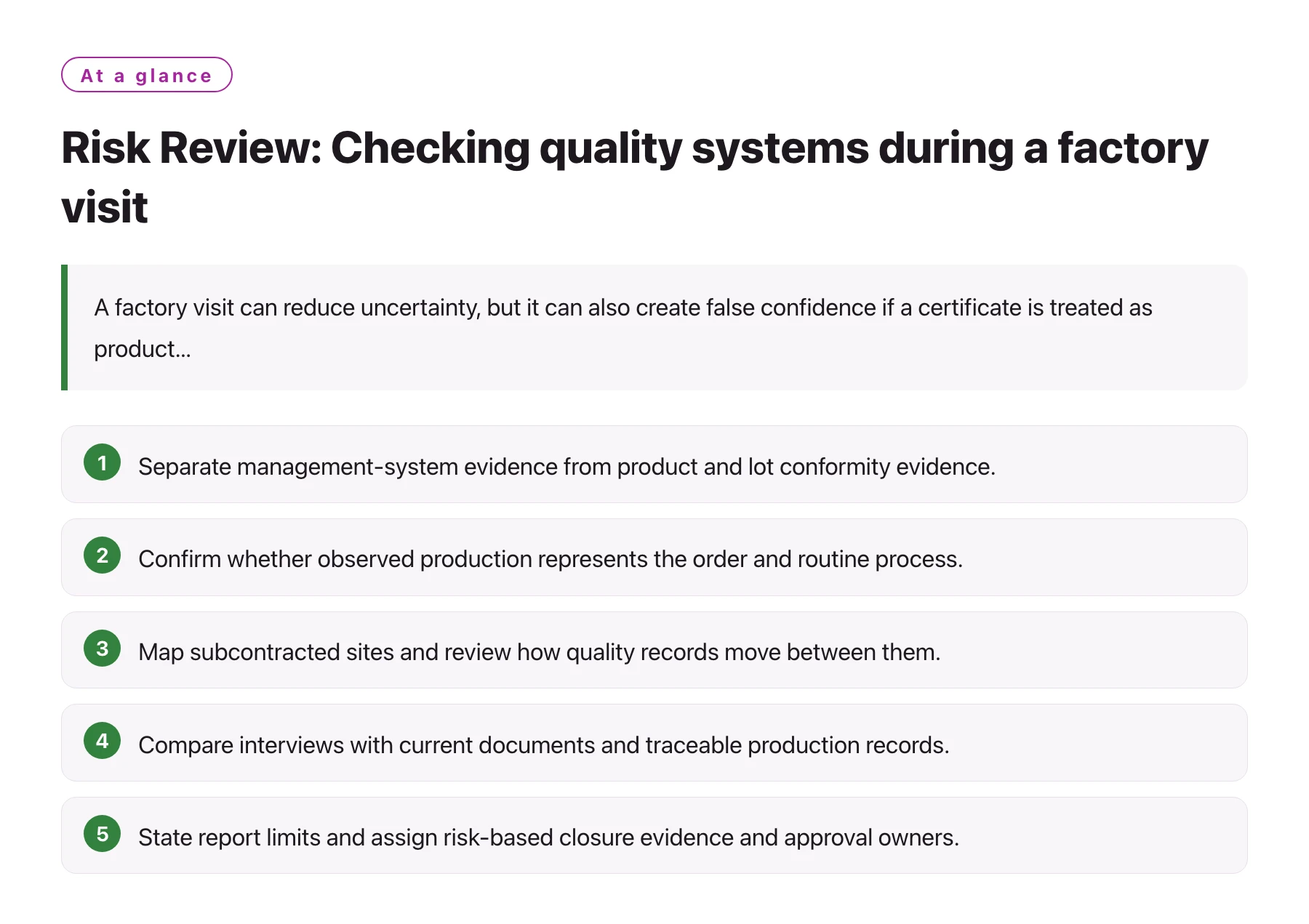
Key takeawaysSeparate management-system evidence from product and lot conformity evidence. · Confirm whether observed production represents the order and routine process. · Map subcontracted sites and review how quality records move between them. · Compare interviews with current documents and traceable production records. · State report limits and assign risk-based closure evidence and approval owners.
Risk-focused reviews are more useful when they target the ways supplier evidence can be incomplete. The aim is to state what was checked, what remains uncertain, and which decisions depend on the answer.
Risk: a certificate is treated as product evidence
A quality-system certificate can help identify a management-system scope, but it does not by itself show that a specific purchase order, model, production line, or lot conforms. During a visit, record the certificate holder, site, activities, issuing body, validity, and any exclusions. Then inspect product-level evidence such as controlled specifications, inspection criteria, lot records, and release decisions.
ISO describes ISO 9001 as a quality management system requirements standard organizations can use to manage and improve processes; certification is not mandatory.[1] The certificate and the product evidence answer different questions. A buyer should state which system controls matter and which product acceptance criteria must be verified for the order.
Ask how the factory translates customer requirements into current drawings, work instructions, inspection plans, and training. Select one requirement and follow it through the controlled document and the production record. If staff use a different revision or cannot connect the criterion to a check, document the gap and its potential effect.
Risk: the visit sample is selected to look successful
Confirm whether production of the relevant item is active, which shift and line are running, and whether the observed units are from the buyer’s order. A demonstration sample or special setup may be appropriate for capability discussion but should not be mistaken for routine output. Record the product identity, lot, process stage, and conditions observed.
Choose records or items for review based on stated criteria and risk. Where feasible, select from a traceable lot rather than accepting only preselected examples. If the supplier limits access or no relevant production is running, record that fact and arrange alternative evidence or a follow-up; do not make a stronger conclusion than the visit supports.
Compare inspection readings to the approved method and limits. Ask how measurement equipment is controlled, how borderline results are handled, and what happens when a result fails. A passing record is more credible when it can be traced to the lot, instrument, operator, and current specification.
Risk: outsourced processes fall outside the assessment
Ask where each critical operation occurs and which company performs it. Mapping, coating, sterilization, assembly, printing, and final packaging may be handled by separate facilities. The main supplier remains responsible for the order only if the commercial and quality arrangements say so; verify how it controls subcontractors and receives their records.
For each outsourced step, identify approval criteria, change notification, traceability, process evidence, and responsibility for nonconformance. Decide whether the buyer needs to assess the subcontractor directly, review its records, or require evidence through the primary supplier. A visit to one facility cannot automatically qualify an undisclosed operation elsewhere.
If the supplier may change a subcontractor or production site, define prior notice and approval. Ask for impact assessment and required sample or testing before the new route is used. Link the approved location to the purchase order or supplier register.
Risk: interviews do not match records or observed practice
Ask operators, supervisors, and quality personnel how a process is controlled and what they do when requirements are not met. Compare their explanations with the current procedure, actual records, and observed work. Differences may point to training, communication, or document-control gaps; capture evidence without assuming why the discrepancy occurred.
Use a qualified interpreter for technical discussions where needed. Repeat key terminology and confirm the meaning of inspection limits, acceptance, rework, and escalation. Note what information came from an interview and what was independently observed. A confident answer is not a substitute for a record or a live demonstration.
Ask a process owner to retrieve the record for a selected production example. Note retrieval time, missing approvals, handwriting or system controls, and whether records link to the lot. If a record is unavailable during the visit, request it through a controlled follow-up and keep the finding open until the agreed evidence arrives.
Risk: findings have no clear consequence or closure criteria
Write findings in a consistent format: requirement, evidence, gap, affected process or product, risk, owner, and due date. Separate an observed fact from a conclusion about severity. A statement that documentation is weak is difficult to act on; identify the missing approval, out-of-date instruction, untraceable lot, or uncontrolled measurement that was observed.
Classify findings using the buyer’s approved method. Decide which gaps block supplier approval, production start, or shipment release and which can be corrected by a later date. Assign a quality owner to approve the classification and communicate it to purchasing so commercial deadlines do not override a quality hold.
Agree how closure will be verified. A revised procedure may address a document gap, while a repeated process issue may require records from a later run or a follow-up visit. Keep evidence of containment, corrective action, and effectiveness review with the finding. Do not close a risk solely because a supplier promised to address it.
Risk: the report overstates what was checked
Before the visit, define duration, site, processes, records, interviews, sample basis, photo rules, and report deadline. State whether the assignment is a system audit, focused process review, or factory tour with observations. These terms should correspond to the work actually performed and the inspector’s competence.
The final report should list scope, criteria, evidence reviewed, unavailable items, limitations, findings, supplier responses, and next decisions. Mark anything not assessed. Use photos to support identifiable observations, with consent and appropriate access control. Keep the report tied to the correct supplier site and order.
For factory-visit quality-system checks in China, buyers may review Learn more for an inspection coordination option. Clarify the assignment scope before booking and retain the buyer’s own quality and supplier approval authority.
Sources
Frequently asked questions
Does an ISO 9001 certificate prove a product meets the buyer specification?
No. It concerns an organization’s quality management system within its scope. The buyer still needs product- and lot-specific evidence against the purchase requirements.
What if the relevant production line is not running during the visit?
Record the limitation and use traceable records, another representative sample, or a follow-up observation. Do not describe the visit as confirmation of routine production if it was not observed.
Should subcontractors be included in supplier review?
Review subcontracted steps that affect product requirements and determine whether direct assessment or supplier-provided evidence is needed. Tie approval to the actual sites and processes assessed.
When is a factory visit finding closed?
Close it when the assigned owner reviews evidence that addresses the gap and meets the agreed verification method. A promise or revised document alone may not prove an implemented correction.