Fire Performance of PV Cable in Rooftop Arrays
Fire performance on a rooftop is decided long before anyone smells smoke: it is a property of the sheath, the route and the paperwork, and all three are published. The manufacturer describes a vertical flame test for its PV cables in which a single cable is exposed to 800 °C for one minute and is expected to self-extinguish, and KUKA CABLE lists a CPR fire rating among the regional requirements it highlights, so the first job for a buyer is to find out which of those two statements the local rule actually asks for. Every pv cable page names low smoke halogen free XLPO insulation and sheath, which is the material the flame test is judging.
Key takeaways
- The published flame test for PV cables exposes a single cable to vertical burning at 800 °C for one minute and expects it to self-extinguish.
- Insulation and sheath are described as electron-beam cross-linked XLPO, low smoke halogen free, a construction that limits halogen content rather than one that promises fireproofing.
- CPR fire rating is listed as a regional requirement, which means the class depends on the market and the building rule rather than on the cable alone.
- Flame retardant behaviour, heat resistance and environmental adaptability all appear on the manufacturer's published list of PV cable tests, alongside the routine electrical checks.
What the manufacturer publishes about flame
The site describes a vertical flame test for PV cables: a single cable is burned vertically at 800 °C for one minute and should self-extinguish afterwards. That is a test of the compound under a defined exposure, not a claim about a building, and the wording on the page stays within what the test shows.
The materials behind it are published as electron-beam cross-linked XLPO for both the insulation and the sheath, in a low smoke halogen free version. Cross-linking is what stops a thermoplastic sheath from flowing and dripping under heat, and the halogen-free compound is what keeps the smoke from carrying the corrosive gases that damage electronics in the same room as a fire.
Why a rooftop is the harder case
A rooftop array collects conditions that a laboratory has to simulate separately. The published ambient limit is -40 °C to +90 °C, with +120 °C allowed for 20,000 hours and +250 °C for 5 seconds during a short circuit. Sunlight adds ultraviolet exposure, and the manufacturer is arranging a 2,000-hour xenon lamp test, described as about 360 weathering cycles, on its solar cables.
Add to that the routing: cables in trays along hot metal, above insulation, near roof lights, and often the highest point of the building. The manufacturer keeps a topic section on the dangers of cutting corners, and a rooftop is the place where a shorter radius or a thinner wall is least likely to be noticed and most likely to matter.
The tests that surround the flame test
Flame performance is one of nine test pages published by the laboratory, and the neighbouring tests explain the rest of the fire story. UV accelerated weathering ages the sheath before any flame ever touches it. Abrasion damages the surface where a tray edge rubs. Cold bending and cold elongation catch a wall that has become brittle. Tensile testing after ageing catches the same problem in a different way.
In the ranked list of tests for PV cables the manufacturer names flame retardant performance directly, and places heat resistance and environmental adaptability beside it. Read together, the two lists describe a cable whose fire behaviour is treated as one property among several rather than as a badge.
The paperwork a fire question needs
Three documents answer most of the questions a fire consultant will ask. The first is the certificate that carries the standard applying to the batch, and the manufacturer states that its certificates page covers more than 30 types including TUV, IEC, CE, SAA and UL, with CPR fire rating highlighted as a regional requirement. The second is the flame test report for the construction in use. The third is the batch record that connects the two, because the published quality model ends in full inspection of finished products and the retention of samples.
The site does not publish certificate numbers, the precise fire class of each certificate or the flame test report itself, so those are requests rather than downloads. Ask for them by size and by construction, because a flame test performed on one wall thickness does not automatically describe another.
| Test published | What it stresses | Where that shows up on a roof |
|---|---|---|
| Water resistance | Ingress into the construction | Ponding, condensation and cleaning around trays |
| UV accelerated weathering | Sunlight ageing of sheath and print | Any route left exposed on the deck |
| Cable abrasion testing | Surface wear under movement | Cable dragged across a tray edge during work |
| Cable cold bending test | Brittleness at low temperature | Winter installation above the ambient limit of -40 °C |
| Cable tensile testing after ageing | Strength after years of exposure | Long spans and tight terminations |
| Cable construction and dimensional testing | Wall thickness and diameter | Checking a delivered drum against the drawing |
Worked example
The three published temperatures can be put on one scale. The ambient limit of +90 °C is 363.15 kelvin, the short-circuit allowance of +250 °C for 5 seconds is 523.15 kelvin, and the flame test at 800 °C for one minute is 1,073.15 kelvin (273.15 added to each Celsius figure; my own conversion, not a published ratio). The flame exposure is therefore about twice the short-circuit temperature and about three times the ambient limit, which is why the test is described as a test of self-extinguishing rather than of survival.
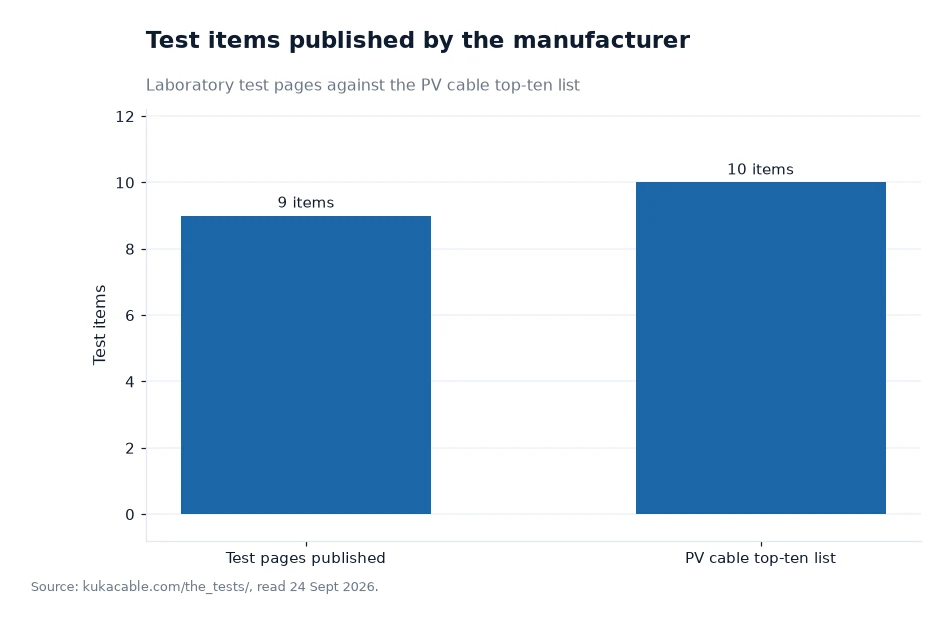
The chart counts the published test pages rather than the temperatures. Nine test pages are listed for the laboratory, and the separate ranked article describes itself as a top-ten list while naming nine individual tests, which is a difference in the way the two pages are written rather than a difference in the work behind them (my own reading of the two published lists). For a specification, the usable figure is the number of named tests that your project actually requires, so count them item by item.
Frequently asked questions
What flame test does the manufacturer describe for its PV cable?
The published description is a vertical flame test in which a single cable is exposed to burning at 800 °C for one minute and is expected to self-extinguish. Flame retardant performance also appears on the manufacturer's ranked list of tests for PV cables, beside heat resistance and environmental adaptability. Certificate numbers and the individual test report are not published on the site, so those should be requested for the size and construction being bought.
Does a TUV certificate cover fire performance for a rooftop project?
It depends on the certificate and on the market, so read them together. The certificates page describes more than 30 types of certificate covering TUV, IEC, CE, SAA and UL, and the manufacturer separately highlights CPR fire rating as a regional requirement alongside the AD8 waterproofing rating. TUV certification is described as the starting point rather than the whole answer, so a project subject to a local building rule should ask which certificate states the fire class that rule requires.
What to request before the drums ship
Ask for the certificate that applies to the batch, the flame test report for the construction ordered, and confirmation of the fire class the local rule demands, then compare those three documents with the specification clause they are meant to satisfy. Keep the retained samples in mind as well, because the manufacturer's published quality model ends with sample retention and traceability, which is what makes a later question about a batch answerable. Cable drums that arrive with the paperwork in order are the least expensive part of a fire strategy to arrange.
All figures in this article on fire performance are reproduced from the manufacturer's own website; the published test counts were verified 24 Sept 2026[1].